Recomienda este artículo a tus amigos:
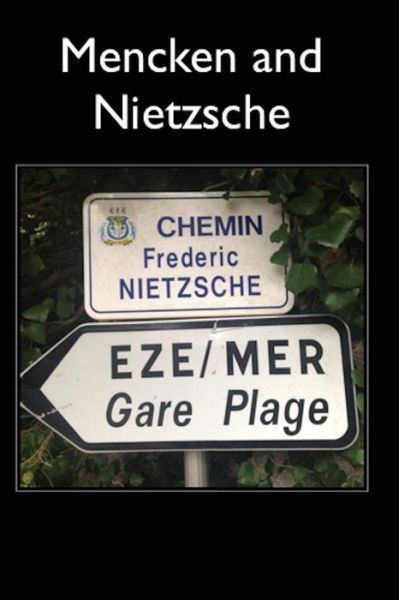
Mencken and Nietzsche H L Mencken


Mencken and Nietzsche
H L Mencken
Publisher Marketing: This volume contains the complete text of two books. H. L. Mencken translated the book The Philosophy of Frederick Nietzsche from the original German. The second book, The Antichrist, was written by F. W. Nietzsche and translated by Mencken, who also wrote the forward. The book has been reformatted for consistency, to produce an accurate Table of Contents, and to display well on modern e-readers. Some redundancy has been removed from available electronic editions. The original manuscripts were used to correct errors of totally garbled text that appear in all the previously published free electronic versions. Mencken was an admirer of Nietzsche's ideas. It appears that some of Mencken's ideas about Jews and blacks (not his term, unfortunately) became more enlightened because of the influence of Nietzsche's writings. The two men had relatively similar, but highly controversial, especially for the time, views of religion. The Central branch of the Enoch Pratt Free Library in Baltimore contains Mencken's papers and many of his books. They are stored, fittingly, in the library's Mencken Room. In 1907, Mencken published a book entitled The Philosophy of Friedrich Nietzsche, continuing his lifetime of study of the work of Nietzsche. Friedrich Wilhelm Nietzsche was October 15, 1844 in the small town of Rocken, in what is now Germany, but was then considered part of the Prussian Province of Saxony. (He did not use the middle name Wilhelm in his most important writings.) He died on August 25, 1900. He was, as was Mencken, an important contributor to many disciplines. He was especially well-known for his writings as a philosopher, poet, cultural critic and philologist. He was a Professor of Philosophy at the University of Basel for ten years, providing him with an ideal occupation in which to pursue his writing. Where Mencken was heavily influenced by reading Twain's Adventures of Huckleberry Finn, Nietzsche may have had his views on religion influenced by the book Life of Jesus by David Strauss while a young man. While Nietzsche was most renowned as a philosopher, and his ideas continue to be influential, in the popular culture that dominates the current era he is, perhaps, most famous for some 1960s era graffiti for both a quotation and a (purported) response. Nietzsche: God is dead. God: Nietzsche is dead. The two men are linked in several ways. Mencken was of German descent and, of course, Nietzsche was born in what became the country of Germany after its unification in 1871. In this volume, Mencken is connected to Nietzsche because of the controversial writings of both men, his aforementioned The Philosophy of Friedrich Nietzsche, and because he both translated Nietzsche's The Antichrist and wrote the forward to it. It is important to understand the language used in this volume. Some of the language used in Mencken's works is considered disgusting and incredibly troubling by modern standards. The racism and sexism are not acceptable in modern society. Indeed, as this introduction is being written, several members of their countries' Olympic teams have been removed from competition in the 2012 London Olympic Games for communicating racist remarks. The use of Nietzsche's work by Nazism to justify its policies is well-known. This volume contains the complete text of two books. H. L. Mencken translated the book The Philosophy of Frederick Nietzsche from the original German. The second book, The Antichrist, was written by F. W. Nietzsche and translated by Mencken, who also wrote the forward. The book has been reformatted for consistency, to produce an accurate Table of Contents, and to display well in print and on modern e-readers. Some redundancy has been removed from available electronic editions. The original manuscripts were used to correct errors of totally garbled text that appear in all the previously published free electronic versions. Contributor Bio: Mencken, H L Friedrich Wilhelm Nietzsche (1844 - 1900) was a German philologist, philosopher, cultural critic, poet and composer. He wrote several critical texts on religion, morality, contemporary culture, philosophy and science, displaying a fondness for metaphor, irony and aphorism. Nietzsche's key ideas include the Apollonian/Dionysian dichotomy, perspectivism, the Will to Power, the "death of God," the Ubermensch and eternal recurrence. One of the key tenets of his philosophy is the concept of "life-affirmation," which embraces the realities of the world in which we live over the idea of a world beyond. It further champions the creative powers of the individual to strive beyond social, cultural, and moral contexts. Nietzsche's attitude towards religion and morality was marked with atheism, psychologism and historism; he considered them to be human creations loaded with the error of confusing cause and effect. His radical questioning of the value and objectivity of truth has been the focus of extensive commentary, and his influence remains substantial, particularly in the continental philosophical schools of existentialism, postmodernism, and post-structuralism. His ideas of individual overcoming and transcendence beyond structure and context have had a profound impact on late-twentieth and early-twenty-first century thinkers, who have used these concepts as points of departure in the development of their philosophies. Most recently, Nietzsche's reflections have been received in various philosophical approaches which move beyond humanism, e.g. transhumanism. Nietzsche began his career as a classical philologist-a scholar of Greek and Roman textual criticism-before turning to philosophy. In 1869, at age twenty-four, he was appointed to the Chair of Classical Philology at the University of Basel, the youngest individual to have held this position. He resigned in the summer of 1879 due to health problems that plagued him most of his life. In 1889, at age forty-four, he suffered a collapse and a complete loss of his mental faculties. The breakdown was later ascribed to atypical general paresis due to tertiary syphilis, but this diagnosis has come into question. Nietzsche lived his remaining years in the care of his mother until her death in 1897, after which he fell under the care of his sister Elisabeth Forster-Nietzsche until his death in 1900.
| Medios de comunicación | Libros Paperback Book (Libro con tapa blanda y lomo encolado) |
| Publicado | 19 de abril de 2013 |
| ISBN13 | 9781484118306 |
| Editores | Createspace |
| Páginas | 422 |
| Dimensiones | 152 × 229 × 22 mm · 562 g |