Recomienda este artículo a tus amigos:
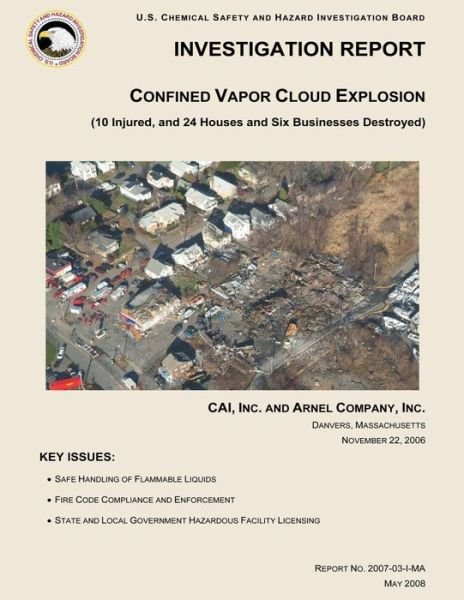
Investigation Report: Confined Vapor Cloud Explosion U S Chemical Safet Investigation Board
Pedido desde almacén remoto
 Los regalos de Navidad se podrán canjear hasta el 31 de enero

Nuestros clientes opinan:


Investigation Report: Confined Vapor Cloud Explosion
U S Chemical Safet Investigation Board
Publisher Marketing: On November 22, 2006, at about 2:45 am, a violent explosion at the CAI/Arnel manufacturing facility rocked the town of Danvers, MA. The explosion and subsequent fire destroyed the facility, heavily damaged dozens of nearby homes and businesses, and shattered windows as far away as two miles. At least 10 residents required hospital treatment for cuts and bruises. Twenty-four homes and six businesses were damaged beyond repair. Dozens of boats at the nearby marina were heavily damaged by blast overpressure and debris strikes. The fire department ordered the evacuation of more than 300 residents within a half-mile radius of the facility. Numerous residents could not return for many months while they waited for their houses to be rebuilt or repaired. Seventeen months after the explosion, six homes had yet to be reoccupied as repairs were not complete. The U. S. Chemical Safety and Hazard Investigation Board (CSB) determined that the explosion was fueled by vapor released from a 2000-gallon tank of highly flammable liquid. An open steam valve on the tank heater most likely caused the flammable liquid to overheat and accumulate in the building production area to what is calculated to have been a near-ideal vapor-air concentration. An unknown ignition source ignited the flammable atmosphere, causing the explosion. The rapidly expanding ignited vapor inside the building created a pressure wave that shattered the rigid, brittle brick walls-disintegrating the structure-and ignited thousands of gallons of flammable liquids stored inside the building and some 51,000 pounds of industrial-grade nitrocellulose material stored nearby. The resultant fire burned for more than 17 hours. On November 22, 2006, at about 2:45 am, a violent explosion at the CAI/Arnel manufacturing facility rocked the town of Danvers, MA. The explosion and subsequent fire destroyed the facility, heavily damaged dozens of nearby homes and businesses, and shattered windows as far away as two miles. At least 10 residents required hospital treatment for cuts and bruises. Twenty-four homes and six businesses were damaged beyond repair. Dozens of boats at the nearby marina were heavily damaged by blast overpressure and debris strikes. The fire department ordered the evacuation of more than 300 residents within a half-mile radius of the facility. Numerous residents could not return for many months while they waited for their houses to be rebuilt or repaired. Seventeen months after the explosion, six homes had yet to be reoccupied as repairs were not complete. The U. S. Chemical Safety and Hazard Investigation Board (CSB) determined that the explosion was fueled by vapor released from a 2000-gallon tank of highly flammable liquid. An open steam valve on the tank heater most likely caused the flammable liquid to overheat and accumulate in the building production area to what is calculated to have been a near-ideal vapor-air concentration. An unknown ignition source ignited the flammable atmosphere, causing the explosion. The rapidly expanding ignited vapor inside the building created a pressure wave that shattered the rigid, brittle brick walls-disintegrating the structure-and ignited thousands of gallons of flammable liquids stored inside the building and some 51,000 pounds of industrial-grade nitrocellulose material stored nearby. The resultant fire burned for more than 17 hours.
| Medios de comunicación | Libros Paperback Book (Libro con tapa blanda y lomo encolado) |
| Publicado | 1 de agosto de 2014 |
| ISBN13 | 9781500483302 |
| Editores | Createspace |
| Páginas | 114 |
| Dimensiones | 216 × 279 × 6 mm · 281 g |